FilmSeries AI OTO – ALL 11 Upsell Links Here >>>
FilmSeries AI is The Breakthrough App That Writes The Script, Casts The Actors, Shoots Every Scene, Performs The Voices, Syncs Every Lip, Scores The Music And Cuts The Whole Thing Together. Handing You A Complete Full-Length Film Series, Part After Part, With The Same Cast And The Same World In Every One.
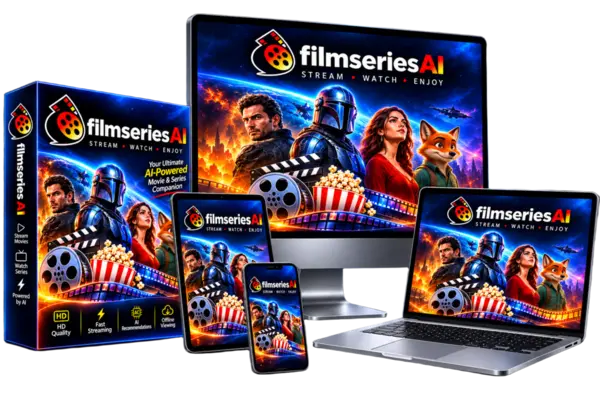
FilmSeries AI OTO Bonuses – Get Film Series AI Today, And These Are Yours Free
The Signature Cast:
A vault of cinema-grade actors, already built and already locked — leads, villains, supporting roles, each with their own face, build, wardrobe and voice. Drop one into a series and they’re yours for every part of it. No first-attempt faces. No starting from a description and hoping.
The Backlot:
Finished locations you can shoot in again and again — the precinct, the diner, the ship’s bridge, the hospital corridor, the street in the rain. What a studio backlot did for the old film companies: build the set once, shoot twenty pictures in it.
The Series Starter Vault:
Finished series premises, already structured, already shaped to hold an audience — thriller, horror, romance, sci-fi, kids’ adventure and more. Pick one, run it, and your first part exists tonight. Nobody stalls on the blank screen.
The Cliffhanger Engine:
The endings that make people click the next part, built into the app as structures you can apply to any story. This is the single thing that separates a series people follow from a series people abandon.
The Genre Look Library:
Colour grades and film looks built per genre — cold Nordic thriller, desert heat, neon rain, soft daylight romance. One click sets the look for a whole series, and every part after it matches.
The Channel Launch Kit:
Banner, avatar, intro sting and end card, built from your series artwork — so the channel your films live on looks like a channel, not a folder, from the first upload.
FilmSeries AI Features and Capabilities
Full-Length Films — not clips, not shorts, films people sit through One Idea In, A Whole Series Out — every part connected to the last
Faces That Never Change — the same people, scene after scene, part after part
Nothing Drifts Between Parts — the town, the car, the scar on his hand, all still there
Cliffhanger Endings Built In — each part pulls viewers into the next
The Script Written For You — scene by scene, start to finish
Acted Voices, Not Robot Narration — every character sounds like a person
Lip Sync That Holds — mouths match the words, in every language
Original Score & Sound Design — scored to the scene, not stock music
Cinematic Shots — angles, lighting and camera movement that look directed
Cut And Edited Automatically — no timeline, no editor, no stitching
Subtitles In Any Language — one film, audiences everywhere
Posters & Thumbnails — made for every part in the series
Titles, Descriptions & Tags — written for each release
Series Memory Kept Automatically — characters, plot and timeline tracked
Any Genre — thriller, romance, horror, sci-fi, action, anything
Unlimited Parts Per Series — you decide how far the story goes
Full Commercial Rights — keep 100% of everything it earns
Lifetime Access — one payment, nothing to renew
No Credits, No Caps, No Watermarks, No Monthly Fees — Ever
How It Works – FilmSeries AI In Three Simple Steps
Step 01: Login
Open Film Series AI in any browser — nothing to install, nothing to set up.
Step 02: Describe Your Series
Type one idea. Pick the genre and the length. Film Series AI builds every part, connected.
Step 03: Publish & Profit
Take your finished films with their posters and listings already made, publish them, and collect what they earn.
Lifetime Access
No Monthly Fees
No Filming
No Experience Needed
Everything It Builds For You
The Script:
Scene by scene, with act structure, pacing and dialogue that sounds like people talking. The ending of each part is written to land on a hook, not to fade out politely.
The Cast:
Characters built once and kept. Age, build, face, hair, wardrobe, the way they carry themselves. Locked, named and reusable across every part of the series.
The Cinematography:
Shot selection, camera movement, lighting and framing chosen for the moment — a wide for scale, a slow push for tension, a handheld for chaos. It looks directed because the choices are directorial.
The Voices:
Every character gets a voice and keeps it. Performance, not narration — pauses, emphasis, anger, exhaustion. The villain sounds like the villain in part one and still sounds like him in part four.
The Lip Sync:
It holds in close-up, which is exactly where every shortcut falls apart. A face filling the frame, a long run of dialogue, and the mouth still matching it word for word. It holds in a two-hander, where one person is talking and the other is listening and reacting. It holds at a side angle. It holds when somebody cuts in mid-sentence. And it holds across the whole series — the same mouth on the same face, part after part.
The Score:
Composed for the scene it sits under, and layered with everything a scene needs to feel real — footsteps on wet pavement, traffic three streets away, rain against glass. No stock library. No copyright claims. No hunting for something that almost fits.
The Edit:
Cut together, paced, colour-matched, titled and credited. You never open a timeline. You never drag a clip. You never line up audio by eye.
The Subtitles:
Burned or sidecar, in whatever languages you want, so one film reaches audiences that don’t speak the language it was made in.
The Poster & Thumbnail:
A key-art poster for each part and a thumbnail built for the platform it’s headed to — the same visual identity across the whole series, so it looks like a franchise instead of a folder.
The Trailer:
A cut-down for every part, built from the film it belongs to — the hook, the stakes, the face you’re supposed to remember — ready to post wherever short-form lives and point people at the full thing.
The Recap:
A short “previously” open for each new part, so somebody who starts at part four isn’t lost, and somebody who watched part three two weeks ago is back in the story within seconds.
And The Listing For Every One Of Them:
Title, description, tags, series order, episode numbering. Written per part, so each one can be found on its own and still points at the rest.
Inside The Dashboard:
No timeline. No layers. No render queue you have to understand.
The Series Shelf:
Every series you’ve built, side by side, with its parts in order underneath it. Click any series to continue it. The app already knows where the story stopped.
The Cast Room:
Every character you’ve created, with their face, voice and wardrobe held against them. Reuse them, retire them, or bring somebody from part one back in part seven. Nothing drifts while it sits there.
The Story Panel:
The premise, the genre, the tone, the length. Four decisions, and most of them are a click rather than a sentence.
The Continuity Log:
What has happened so far, who knows what, what was established and cannot be contradicted. Kept automatically, so part six doesn’t quietly undo part two.
The Finished Library:
Every completed film with its poster, title, description and tags attached, ready to download or send on. Files in the formats the platforms want, at the sizes they want them.
That’s the whole app:
The complexity is on our side. Your side is a premise and a button.